
Bangkok Outdoor Wedding Fabric Guide 2026
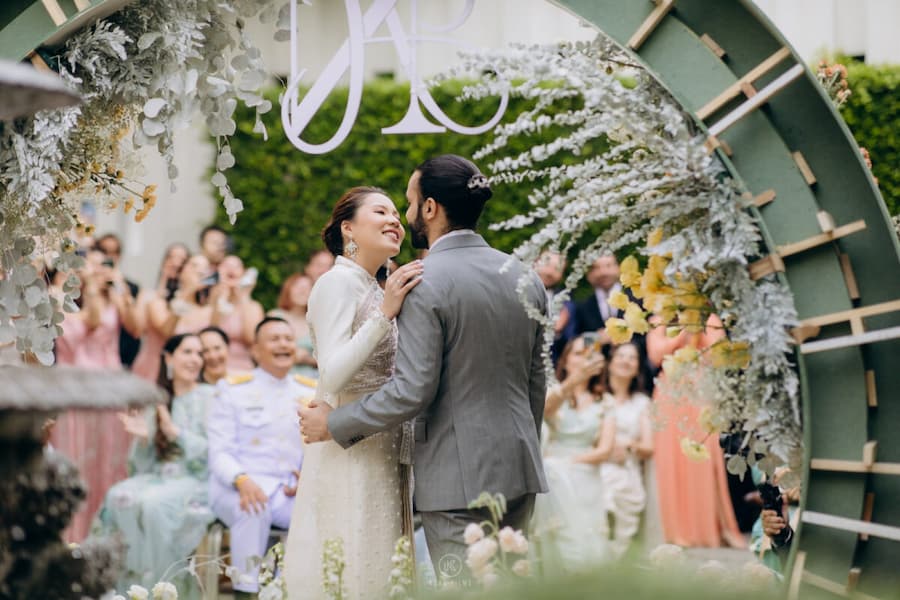
Bangkok does not do outdoor weddings quite like other destinations.
When a venue describes itself as outdoor-capable, that might mean a garden terrace connected to an air-conditioned ballroom, a rooftop ceremony followed by an indoor reception, or a covered pavilion that keeps the sun away while leaving Bangkok's humidity very much present.
Bangkok regularly combines temperatures above 30°C with high relative humidity, which can sometimes reach 70–90%. That combination changes what makes a wedding fabric practical. A dress that feels beautifully light in an air-conditioned fitting room can feel very different after 30 minutes outside.
For brides, bridesmaids, mothers of the bride and wedding guests, choosing the best fabrics for an outdoor wedding in Thailand is therefore about more than selecting something "lightweight." Breathability, weave, lining, drape, wrinkle resistance, colour and the amount of time spent outdoors all matter.
This guide looks specifically at lightweight fabrics for outdoor Bangkok weddings, from chiffon and georgette to crepe, organza and lace, including how they behave in Bangkok heat, how they photograph, how they travel, and which options make the most sense for different wedding roles.
Why Does Bangkok Need Different Outdoor Wedding Fabric Advice?
Most wedding fabric guides begin with a simple rule: if the wedding is outdoors and the weather is warm, choose lightweight fabrics.
That is technically correct, but it misses what makes Bangkok different.
High humidity makes it more difficult for perspiration to evaporate efficiently, reducing the body's ability to cool itself. A fabric therefore needs to do more than simply feel thin. It should allow air movement and avoid trapping unnecessary heat close to the body.
Fabric weight also needs to be considered alongside weave.
A very thin but tightly constructed fabric is not automatically cooler than a slightly heavier material with better airflow. Thread structure, weave density, lining and garment construction all affect how comfortable the finished dress will feel.
Then there is Bangkok's indoor-outdoor wedding culture.
A hotel wedding may involve:
-
photographs outside in the afternoon
-
an outdoor garden or rooftop ceremony
-
cocktails on a terrace
-
an air-conditioned ballroom reception
-
repeated transitions between hot, humid air and strong indoor air conditioning
That means your outfit has to perform in more than one environment.
Photography adds another consideration. Silk and some smooth blends may make moisture marks more noticeable, while inexpensive polyester can sometimes look overly shiny under flash. Metallic threads and heavy embellishment can also interact strongly with lighting.
None of this means those materials should automatically be avoided. It means the whole outfit needs to be considered in the conditions where it will actually be worn.
Before choosing a fabric, ask:
-
How long will the ceremony be outdoors?
-
Will there be direct sun?
-
Is the reception indoors or outdoors?
-
Will you be walking between spaces?
-
How much movement and dancing is expected?
-
Does the dress need to survive an international flight?
-
How much time will you have for steaming or alterations after arriving?
These questions are far more useful than simply asking for the lightest fabric available.
Which Wedding Fabrics Perform Best in Bangkok Heat and Humidity?
Different fabrics solve different problems in Bangkok humidity.
| Fabric | Breathability | Elegance | Wrinkle Resistance | Best For |
|---|---|---|---|---|
| Chiffon | Excellent | High | Poor | Bridesmaids, overlays |
| Georgette | Excellent | High | Moderate | Mother of bride, formal guests |
| Crepe | Very Good | High | Good | Bride, bridesmaids |
| Organza | Good | High | Moderate | Overlays, structured elements |
| Lace | Good | High | Poor | Garden weddings, overlays |
| Tulle | Good | Moderate | Good | Veils, voluminous overlays |
| Satin Blend | Moderate | Very High | Good | Evening, indoor-outdoor weddings |
| Cotton Blend | Excellent | Moderate | Good | Casual daytime guests |
Chiffon leads in lightness and movement, but its weak point is wrinkle recovery.
Crepe is one of the strongest all-round performers because it balances breathability, drape and wrinkle resistance better than many alternatives.
Georgette sits between the two, offering much of chiffon's movement while providing greater structure.
The right answer depends on who is wearing the garment and how long they will actually be outside.
Why Is Chiffon a Good Choice for Bangkok Bridesmaids?
Chiffon remains one of the most commonly recommended breathable wedding fabrics in Thailand for good reason.
It is lightweight, moves beautifully, photographs well and works particularly effectively for bridesmaid dresses, flowing skirts, sleeves and overlays.
For a wedding that begins outdoors and moves indoors later, chiffon also transitions easily between the softer appearance of a garden ceremony and the formality of a hotel reception.
Its main Bangkok challenge is wrinkle recovery.
Chiffon can crease deeply during international travel, and stubborn packing creases may remain visible even after steaming. Bridesmaids travelling with their dresses should therefore unpack them immediately after arriving rather than leaving them folded until the wedding morning.
Professional steaming should ideally be planned into the getting-ready schedule several hours before the ceremony.
Colour deserves consideration too.
Dark shades absorb more solar heat than pale ones. On certain chiffon constructions, moisture can also cause temporary darkening or make perspiration more visible. Navy, burgundy and deep emerald can still look beautiful, but bridesmaids spending significant time outdoors should consider how the exact fabric behaves when damp.
Blush, champagne, silver and other lighter shades can sometimes be more forgiving in hot outdoor conditions.
Chiffon also catches relatively easily on jewellery, rough accessories and other fabrics. Statement jewellery with sharp edges should be worn carefully, while fashion tape or another simple hem-management solution can help prevent very loose layers from catching during movement.
Most importantly, examine the lining.
A breathable chiffon outer layer loses much of its advantage when it is sewn over a thick synthetic lining.
Is Georgette Better Than Chiffon for More Structured Wedding Looks?
Georgette is closely related to chiffon in appearance but generally feels slightly heavier and more substantial.
Its textured surface provides a softer matte finish, which can work particularly well for formal wedding photography where a highly reflective fabric is not desired.
That combination makes georgette particularly useful for mothers of the bride, formal guests and bridesmaids who want movement without the delicacy of very fine chiffon.
It also tends to recover from wrinkles more reliably than chiffon.
The main issue in Bangkok is cling.
In humid conditions, fitted georgette can begin to sit closer to the body, particularly around the waist and hips. Dresses with some movement through these areas usually feel better than very restrictive silhouettes.
Lining can help here too.
A smooth, breathable lining such as silk habotai or an appropriate lightweight crepe-backed lining creates a layer between the outer fabric and skin, helping the dress move without adding unnecessary bulk.
For someone who loves chiffon but wants slightly more structure and reliability, georgette is often the easier compromise.
Why Does Crepe Work So Well for Bangkok Outdoor Weddings?
Crepe deserves serious consideration for anyone researching hot weather wedding attire in Bangkok.
Its characteristic textured surface naturally disguises some minor creasing, while its weight gives a garment enough body to create a polished silhouette without requiring the same amount of stiff internal structure as many heavier formal fabrics.
A well-selected crepe can therefore work for the bride herself, bridesmaids or formal guests.
Its biggest advantage in Bangkok is the combination of structure and airflow.
Depending on fibre composition and weave, a moderate-weight crepe can feel remarkably comfortable because air can move through the fabric rather than being trapped by a dense, smooth construction.
It also photographs reliably.
The subtle surface texture catches natural and artificial light without producing the intense shine associated with some satin or synthetic fabrics, making crepe useful for weddings that move between daylight, sunset photography and flash-lit evening receptions.
Wrinkles are another strength.
Crepe does not necessarily resist every crease, but minor wrinkles are usually less visually obvious because they disappear into the fabric's existing texture.
That makes it particularly useful for destination wedding parties travelling with formalwear.
The disadvantage is price.
High-quality crepe can cost noticeably more than basic chiffon or polyester alternatives, especially when enough fabric is needed for a full-length dress or a complex design.
But for a garment that will be worn through several hours of Bangkok heat, photography and an evening reception, that added investment can make practical sense.
When Should You Choose Organza for an Outdoor Wedding?
Organza creates volume without the physical weight of many traditional structured fabrics.
That makes it particularly effective for statement sleeves, overlays, overskirts, bodice details and veils.
For Bangkok weddings, its best role is often structural rather than primary.
An otherwise lightweight dress can use organza to create a dramatic silhouette without making the entire garment heavier.
Organza also wrinkles less aggressively than very fine chiffon. Small creases can be less obvious because the fabric already has a crisp, structured appearance.
The trade-off is that layers add up quickly.
A single organza overlay may feel light and airy. Several layers of organza, lining and underskirt can behave very differently in humid weather.
This is why full organza gowns need to be evaluated based on the finished construction rather than the weight of an individual fabric sample.
Is Lace Suitable for a Bangkok Garden Wedding?
Lace naturally suits Bangkok garden weddings because it provides texture and romance without relying on heavy embroidery or beading.
However, not all lace behaves the same way.
More delicate, open lace can absorb moisture and lose some crispness after prolonged exposure to humid conditions. Dense or heavily embellished lace can create the opposite problem by adding more weight and reducing airflow.
For a Bangkok outdoor wedding, lace often works best as an overlay or selected detail over a more practical base fabric.
The type of lace also matters.
Alençon-style and guipure laces generally provide more structure than very delicate Chantilly lace, whose fine net background and open pattern make it more vulnerable to stretching, snagging and changes in appearance when handled repeatedly.
For a fully exposed outdoor ceremony, a more structured lace can therefore be easier to manage.
For a covered garden pavilion or short outdoor ceremony followed by an indoor reception, delicate lace becomes much easier to wear.
Again, venue matters as much as fabric.
Which Fabric Works Best for Each Wedding Role?
Once the characteristics of each fabric are understood, the next decision becomes easier: match the material to what the person actually needs to do during the wedding.
The Bride
The bride usually has the longest day and the greatest amount of photography.
Crepe is one of the strongest choices for a clean, modern gown because it balances movement, elegance and wrinkle resistance.
A bride who prefers something softer can use chiffon, lace or organza as an overlay while keeping the underlying construction relatively lightweight.
A second reception look is another practical option for Bangkok weddings, especially when a formal outdoor ceremony is followed by several hours of dancing indoors.
Bridesmaids
Chiffon, georgette and crepe are all strong choices.
Chiffon provides the most obvious movement. Georgette offers a little more structure. Crepe works well when wrinkle resistance and a cleaner silhouette matter more.
Colour and photography also matter when several bridesmaids need to look coordinated under changing lighting.
Jesse & Son already covers the wider considerations around coordinating a Bangkok wedding party in its Groom & Bridesmaid Tailoring for Bangkok Weddings guide, including fit, fabric weight, colour and mobility. This fabric guide therefore focuses more specifically on what the materials themselves do in heat and humidity.
Mother of the Bride and Formal Guests
Georgette and crepe are particularly useful for formal roles because they offer greater structure than very light chiffon.
Richer colours also tend to suit these garments well.
If darker shades are being considered for a daytime outdoor ceremony, however, remember that they absorb more solar heat than lighter colours. The cut should therefore allow enough movement and ventilation to compensate.
Wedding Guests
Guests have far more freedom.
Crepe and georgette work well for formal hotel weddings, chiffon suits softer evening dresses, and cotton or linen blends can work for less formal daytime celebrations.
International visitors who would rather have something made after arriving can also explore Jesse & Son's Bangkok tailoring services. The company offers custom garments for both men and women, making local fittings an option for guests who do not want to transport formalwear internationally.
How Should You Pack Wrinkle-Prone Wedding Fabrics for Thailand?
For destination weddings, what happens before the event can be almost as important as fabric selection.
Chiffon and organza are particularly vulnerable to packing creases.
A few practical steps help:
-
Place tissue paper between delicate fabric layers.
-
Avoid creating sharp folds wherever possible.
-
Roll softer garments loosely rather than compressing them.
-
Use a garment bag as protection.
-
Unpack everything immediately after arriving.
-
Arrange steaming well before the ceremony rather than waiting until everyone is dressed.
A rolling suitcase can sometimes offer better physical protection than checking a soft hanging garment bag because the dress is less exposed to crushing and snagging during handling.
Once in Bangkok, ask the hotel whether garment pressing or steaming is available. Many full-service hotels can assist directly or recommend a nearby service.
For stubborn minor creases, a wrinkle-release spray can also provide a useful backup after steaming. Test it on an inconspicuous section first, particularly with delicate or coloured fabrics.
If alterations are likely, build those into the trip as well.
Jesse & Son's custom tailoring process shows how fabric selection, measurements, cutting, fitting and final adjustments fit together. For international wedding guests or bridesmaids, understanding this process before arriving makes it easier to plan realistic fitting time.
Where Can You Source Quality Wedding Fabrics in Bangkok?
One of Bangkok's advantages as a tailoring destination is access to both imported and locally sourced textiles.
The wider Pratunam textile and wholesale area is well known for fabric and garment sourcing, while professional tailoring houses maintain their own supplier relationships and fabric collections.
That means visitors do not necessarily need to buy fabric overseas and transport it into Thailand.
For custom wedding clothing, working with a local tailor can simplify the process because the fabric, lining and garment construction can all be evaluated in Bangkok's actual climate.
Rather than asking only:
"Is this chiffon?"
A more useful conversation is:
-
What fibre is it made from?
-
How dense is the weave?
-
How does it recover after being crushed?
-
What lining will be used?
-
How many layers will the finished dress have?
-
Will it be worn outdoors for 20 minutes or three hours?
-
Is the venue shaded?
-
Will the garment travel internationally afterward?
Jesse & Son's fabric collection is handpicked from mills around the world, with light- and medium-weight options available for different garment requirements.
This is where local sourcing becomes useful.
A fabric that looks similar to another on a screen can behave very differently when handled. Seeing the material in person makes it possible to compare drape, transparency, weight, texture and recovery before committing to the finished garment.
For a wedding party, a Bangkok tailor can also coordinate those decisions across several garments rather than treating each dress independently.
Should You Bring a Wedding Outfit From Abroad or Have It Tailored in Bangkok?
For destination wedding guests and bridesmaids, the final decision is often whether to bring an existing dress or have something made in Bangkok.
Bringing a dress from home provides certainty. You already know the design, colour and fit before travelling.
The downside is transportation.
Chiffon and organza can arrive heavily creased, elaborate dresses take up valuable luggage space, and there may be limited options if alterations become necessary after arriving.
Having the garment made locally changes those trade-offs.
You can assess the fabric in person, choose construction appropriate for Bangkok conditions and complete fittings locally. Depending on the fabric and design, custom tailoring in Bangkok may also be comparable in cost to purchasing formalwear internationally.
It is not automatically the better choice for everyone.
The wedding date, arrival schedule and amount of fitting time available should decide whether local tailoring is realistic.
For travellers arriving only a day before the event, bringing a finished garment is usually safer. For guests staying several days or wedding parties planning ahead, custom outdoor wedding attire in Bangkok becomes much more practical.
The important point is to make that decision early rather than treating fabric and fitting as last-minute details.
What Are the Best Fabrics for an Outdoor Wedding in Bangkok?
At Jesse & Son, we believe Bangkok wedding clothing should be designed around the conditions in which it will actually be worn. Chiffon, georgette, crepe, organza and lace can all look beautiful, but fabric weight, weave, lining, structure and venue matter just as much as the material name itself. Whether you are a bride, bridesmaid or wedding guest, working with an experienced Bangkok tailor can help you choose fabrics and construction that suit the city’s heat, humidity and indoor-outdoor wedding settings.
Frequently Asked Questions About Bangkok Outdoor Wedding Fabrics
What fabric is best for an outdoor wedding in Bangkok humidity?
Crepe, georgette and chiffon are among the strongest choices. Crepe offers a particularly useful balance of structure, breathability and wrinkle resistance, while chiffon provides maximum lightness and movement. The finished garment's lining and construction are just as important as the outer fabric.
Is chiffon or georgette better for a Thailand wedding?
Chiffon is lighter and creates more movement, which makes it particularly popular for bridesmaids. Georgette has slightly more weight and structure and generally handles wrinkles better. For long outdoor ceremonies, either can work when paired with a lightweight, breathable lining.
What is the best wrinkle-resistant fabric for a destination wedding?
Crepe is one of the most practical options because its natural surface texture makes minor creasing less visible. Georgette is another good choice. Chiffon looks beautiful but usually requires more care after travelling.
What colours are best for an outdoor Bangkok wedding?
Light and medium shades can be practical for long daytime ceremonies because darker colours absorb more heat from direct sunlight. However, colour should also be considered alongside the venue, dress code, fabric construction and amount of time spent outdoors.
Can I get a bridesmaid or wedding guest dress tailored after arriving in Bangkok?
Yes, but contact the tailor before travelling. Provide your arrival date, wedding date, number of garments and preferred styles so there is enough time for measurements, fittings and any necessary corrections.
How should I pack chiffon for a destination wedding in Thailand?
Avoid sharp folds and heavy compression. Use tissue between layers where practical, protect the garment inside a garment bag, unpack it immediately after arriving and arrange steaming before the wedding. Chiffon is particularly prone to visible packing creases.
Is crepe too heavy for a Bangkok outdoor wedding?
Not necessarily. Crepe is available in different fibres, constructions and weights. A lighter or moderate-weight crepe can provide good airflow while maintaining more structure than chiffon. Always evaluate the actual cloth and lining rather than choosing based only on the fabric name.
What should I wear to a wedding that moves between an outdoor ceremony and an air-conditioned Bangkok hotel?
Choose a fabric that remains comfortable outside but still has enough structure for a formal indoor reception. Crepe, georgette and chiffon are versatile options. A shawl or removable layer can also help with the temperature difference once you move indoors.
 +66814437747
 @jesseandson