
Women’s Bespoke Tailoring for Curved Body Shapes in Bangkok
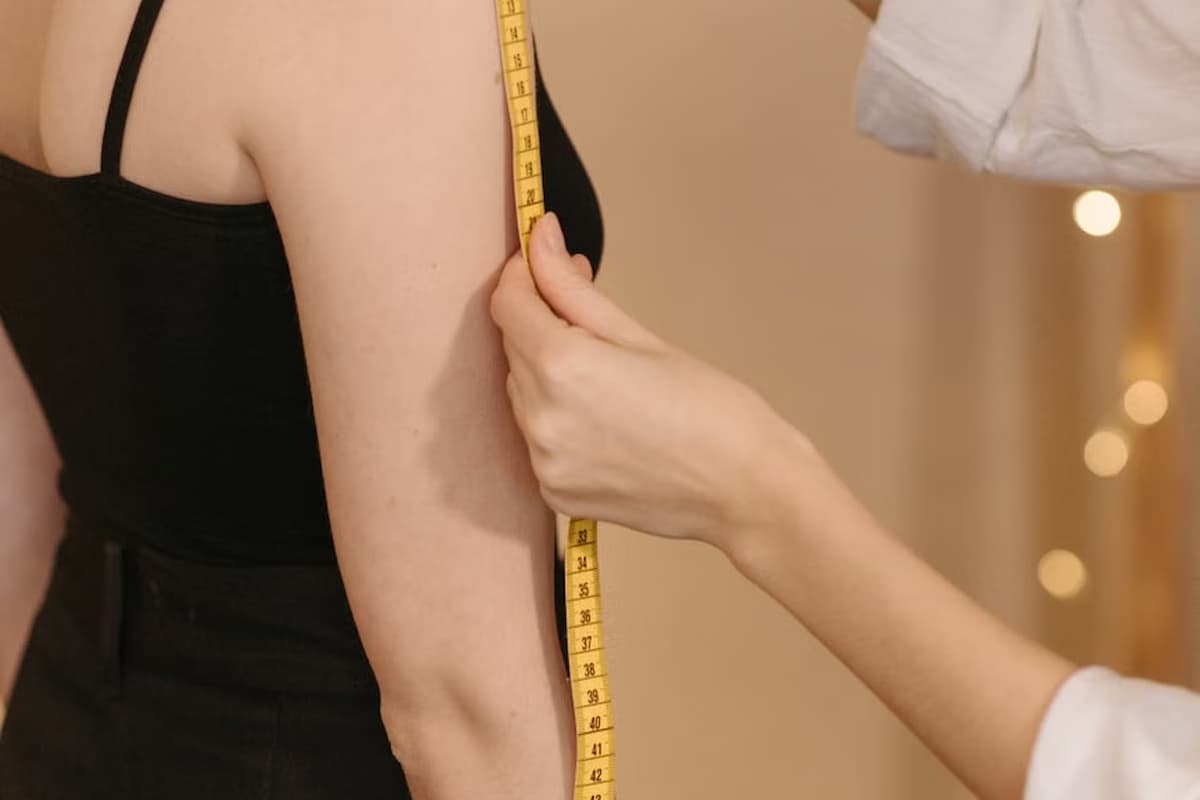
A standard body measurement records a number. A good bespoke measurement records a shape.
The difference becomes obvious when a garment technically matches your measurements but still does not sit properly. The shoulders appear correct, the waist is the right circumference and the trousers are the right length, yet the jacket pulls when you move, the waistband gaps at the back or a dress falls differently over one hip.
The problem is not always the measurement itself. Bodies are three-dimensional, rarely perfectly symmetrical and affected by posture, muscle distribution and the way we naturally stand and move.
That is why measuring curved body shapes for women's bespoke tailoring requires more than bust, waist and hip numbers. An experienced tailor needs to understand where those curves sit, how one side differs from the other and how the body changes the balance of the garment.
For women considering bespoke clothing in Bangkok, understanding this process can make it much easier to judge whether a tailor is genuinely building around your body or simply adapting a standard size.
How Do Different Body Shapes Affect Bespoke Fit?
Terms such as hourglass, pear, apple and inverted triangle are useful shorthand, but they should never become rigid rules. Two women described as having the same body shape can still require completely different patterns.
What matters to a tailor is how the body's proportions affect the garment.
| Body Shape | Typical Proportion | What the Tailor Needs to Consider |
|---|---|---|
| Hourglass | Bust and hips are relatively balanced with a more defined waist | Waist shaping, bust and hip contours, dart position and avoiding pulling across curved areas |
| Pear | Hips are proportionally wider than the upper body | Allowance through the hip and seat while maintaining a clean fit through the waist and upper body |
| Apple | Greater volume through the waist and midsection | Front balance, body depth, waist placement and fabric drape |
| Inverted Triangle | Shoulders or bust are broader relative to the hips | Shoulder balance, jacket structure and visual proportion between upper and lower body |
An hourglass figure, for example, cannot simply be treated as a smaller waist between two larger circumferences. The position of the bust, waist and fullest part of the hip determines where darts, seams and shaping need to occur.
A pear-shaped figure may require considerably more room through the hip without making the jacket or trousers unnecessarily loose elsewhere. For an apple-shaped body, front-to-back depth may be just as important as circumference.
These categories therefore help identify potential fitting challenges, but body shape tailoring becomes truly bespoke only when the tailor stops thinking in categories and starts examining the individual body.
What Measurements Are Needed for Curved Bodies?
If you are researching how to measure a curvy body for tailoring, the first thing to understand is that no single universal measurement checklist creates a bespoke pattern.
A professional tailor may take considerably more measurements depending on the garment. Jesse & Son's own tailoring process, for example, describes patterns created using more than 20 measurement entries together with observations of build, stance and posture.
For curved women's garments, these 18 areas illustrate the type of information a tailor may need to consider:
| Measurement Area | What Is Assessed | Why It Matters |
|---|---|---|
| 1. Full Bust | Overall bust circumference | Establishes the main upper-body dimension |
| 2. Underbust | Circumference beneath the bust | Shows how quickly the torso narrows below the bust |
| 3. Natural Waist | Natural waist position and circumference | Prevents the pattern from assuming where the waist should sit |
| 4. High Hip | Upper-hip circumference | Captures the transition between waist and full hip |
| 5. Full Hip and Seat | Widest point through hips and seat | Determines lower-body allowance and shaping |
| 6. Shoulder Width | Natural shoulder span | Establishes jacket and blouse proportions |
| 7. Shoulder Slope | Angle from neck to shoulder | Helps prevent pulling, collapsing or uneven shoulder lines |
| 8. Front Body Length | Shoulder through bust to waist | Accounts for bust projection and front balance |
| 9. Back Body Length | Shoulder line to waist | Helps balance the garment front to back |
| 10. Bust Apex Position | Location of the fullest point of each bust | Guides dart and seam placement |
| 11. Bust Span | Distance between bust apex points | Helps position shaping correctly |
| 12. Upper Arm | Circumference at the fullest part | Affects sleeve comfort and mobility |
| 13. Arm and Sleeve Length | Length of each arm | Allows differences between left and right sides to be identified |
| 14. Side Body Length | Underarm to waist or hip on each side | Helps reveal lateral asymmetry |
| 15. Waist-to-Floor or Trouser Length | Vertical length on each side | Highlights hip or leg-balance differences |
| 16. Thigh | Circumference through the upper leg | Important for trousers and fitted skirts |
| 17. Rise and Body Depth | Front-to-back depth through the pelvis | Influences trouser and skirt balance |
| 18. Posture and Stance | Natural alignment while standing and moving | Shows how the garment needs to balance on the actual body |
This is why a measurement sheet cannot tell the whole story.
Someone may have identical waist and hip circumferences to another client but carry those proportions differently from front to back. Bust position can differ. One hip can sit slightly higher. One shoulder can slope more sharply.
For anyone taking preliminary measurements before an appointment, Jesse & Son's guide to taking suit measurements before visiting a Bangkok tailor covers the basic tape-measure process in more detail. Those numbers are useful preparation, but they should not replace an in-person assessment for a garment requiring precise curved-body fit.
Why Is It Important to Measure Both Sides of the Body?
Perfect bilateral symmetry is not the norm in human anatomy.
One shoulder may naturally sit lower. One hip may appear fuller or higher. Arms can hang at slightly different angles, and small differences between leg lengths are common.
Research reviewing radiographic measurements has found some degree of anatomical leg-length inequality in around 90% of people, with an average difference of approximately 5.2 mm. Most differences are small, but they illustrate why automatically assuming that the left and right sides of the body are identical can create fitting problems.
For tailoring, the significance is practical rather than medical.
If one shoulder sits differently, cutting identical shoulder slopes and sleeve positions can make one side of a jacket appear longer or cause diagonal pulling. If one hip is higher or fuller, trousers may appear uneven even when both trouser legs have technically been cut to the same length.
A skilled tailor therefore observes the client from the front, side and back rather than simply circling the body with a tape measure.
The purpose is not to exaggerate every tiny difference. It is to determine which differences are large enough to affect the way the garment hangs.
How Does Posture Affect Bespoke Fit?
Body shape explains only part of the equation. Posture has a major impact on fit because garments hang from a moving structure rather than a static set of circumferences.
Consider two women with almost identical bust, waist, hip and shoulder measurements. One stands relatively upright. The other naturally carries her shoulders slightly forward after years of working at a desk.
Using the same basic pattern for both can produce noticeably different results.
Forward Shoulders and Forward Stance
When the upper body naturally sits farther forward, the balance between the front and back of a jacket changes. The back, armhole and sleeve pitch may need adjustment so the jacket remains comfortable when the wearer reaches forward or sits.
Pelvic Tilt
The angle of the pelvis changes how skirts and trousers sit through the waist, seat and rise. A waistband that looks level on a pattern can appear higher at the front or back once it is worn.
Rounded or Elevated Shoulders
Shoulder position affects the neckline, armhole, sleeve cap and overall jacket balance. Treating the shoulder simply as a width measurement misses the angle from which the garment actually hangs.
Lateral Hip Balance
If the pelvis naturally shifts toward one side, the apparent relationship between the waist, hips and legs changes. Trousers or skirts may therefore require different balancing from left to right.
For professional women who spend much of the day sitting, walking between meetings or working at a desk, these details matter because a garment should still feel balanced during normal use, not only while standing perfectly upright in front of a fitting-room mirror.
How Does Contour Mapping Go Beyond Standard Body Measurements?
This is where contour measurement in bespoke tailoring separates itself from simple measurement.
A tape measure can tell a tailor that a bust is a certain circumference. It cannot, by itself, explain how far that bust projects forward, where the fullest point sits, how rapidly the torso narrows toward the waist or how the curve transitions into the hip.
The same applies to trousers. Waist and hip measurements do not fully describe the shape of the seat, pelvic angle or the relationship between the front and back rise.
Expert pattern cutting therefore combines numbers with visual information.
The tailor is effectively mapping three things:
-
Proportion: where the body's major measurements sit relative to one another.
-
Contour: how the body changes between those measurement points.
-
Balance: how posture and asymmetry affect the garment from left to right and front to back.
That distinction is particularly important for women's body measurements in bespoke tailoring, because bust shaping, waist definition and hip contour can produce substantial three-dimensional changes over relatively short distances.
The choice of cloth then affects how successfully those contours can be expressed. Women building professional wardrobes can explore Jesse & Son's guide to fabrics for easy movement in women's bespoke wear for a deeper look at drape, recovery and structure.
What to Expect at Your First Women's Bespoke Fitting in Bangkok
A proper first appointment should begin with a conversation, not a measuring tape.
Your tailor needs to understand what you want the garment to do. A structured blazer worn for presentations has different requirements from relaxed office trousers, an evening dress or a complete tailor-made women's wardrobe in Bangkok.
At Jesse & Son, the published bespoke process combines individual measurements with notes on build, stance and posture before an individual pattern is created. The broader Bangkok bespoke tailoring process also explains why fittings are used to refine balance and movement rather than simply confirm circumference.
For a curved body, the first consultation should address:
-
where off-the-rack clothing normally feels too tight or too loose;
-
whether jackets tend to pull across the bust or hips;
-
whether trouser waistbands commonly gap;
-
your preferred amount of waist definition;
-
how fitted or relaxed you want the garment to feel;
-
your usual shoes and working environment;
-
how much sitting, walking or reaching the garment needs to accommodate.
The fitting itself should not be entirely static. Sit down. Walk. Raise your arms. Button and unbutton the jacket. Check trousers while seated as well as standing.
A garment that photographs perfectly for ten seconds but becomes uncomfortable during an eight-hour working day has not achieved the purpose of bespoke tailoring.
What Questions Should You Ask Before Choosing a Bangkok Tailor?
For someone commissioning bespoke women's suits in Bangkok for the first time, transparency is one of the clearest indicators of whether the process will suit you.
Ask:
How much experience do you have with women's curved body types?
Look for an explanation of actual fitting and pattern adjustments rather than a generic statement that every body can be accommodated.
How do you identify and adjust for asymmetry?
The tailor should be comfortable discussing shoulder balance, hip position, posture and differences between the two sides.
Will my pattern be created specifically for me?
Understanding whether the garment is bespoke or based on an adjusted standard pattern helps set realistic expectations.
What happens during the fittings?
Ask what the tailor checks and whether movement and posture are assessed as well as static appearance.
How many fittings might my garment require?
There is no single correct number for every commission. More complex garments or first-time patterns may require additional refinement.
What happens if an adjustment is still required at the final fitting?
A clear alteration or revision policy is more reassuring than a promise that everything will automatically be perfect the first time.
Can you recommend fabric based on my garment and fit requirements?
The correct fabric should support the pattern. Structure, drape, recovery and Bangkok's climate can all influence the final result.
For someone who has spent years compromising between a jacket that fits the shoulders and one that fits the hips, this conversation may be more important than choosing lapels, buttons or lining. It tells you whether the tailor understands the reason you are considering bespoke in the first place.
What Should You Know About Measuring Curved Bodies for Bespoke Tailoring?
At Jesse & Son, we believe women's bespoke tailoring should begin with the body that will actually wear the garment, not an assumed standard of symmetry or proportion. Measurements provide the foundation, but contour, posture, movement and individual asymmetry are what turn those numbers into a pattern that works in everyday life. If you are looking for a Bangkok suit tailor for professional suits, jackets, trousers or other custom women's garments, the measurement process should give you confidence that the garment is being designed around you rather than asking your body to accommodate an existing shape.
What Are the Most Common Questions About Women’s Bespoke Tailoring?
Can a Bangkok tailor make clothing for plus-size or very curvy women?
Yes, provided the tailor has appropriate experience with individual pattern cutting and women's garments. For measuring a plus-size body for custom clothes in Bangkok, circumference alone is not enough. Bust position, body depth, hip shape, posture and movement should also be considered.
Do I need to lose weight before ordering bespoke clothing?
No, you do not need to lose weight before ordering bespoke clothing if that is not already part of your plan. Bespoke clothing is made around your current body and proportions. If you expect a significant weight change in the near future, let your tailor know so they can advise on timing and how much future alteration may be possible.
Can I take measurements at home before visiting the tailor?
Yes. Home measurements can help you prepare and communicate with the tailor, particularly before travelling. They should generally be treated as preliminary information rather than a substitute for an in-person fitting when precise bespoke fit is required.
What if one shoulder or hip is higher than the other?
Small asymmetries are common. A tailor can assess whether the difference is significant enough to alter the pattern, shoulder slope, garment balance, hem or trouser construction rather than automatically making both sides identical.
Is bespoke better than alterations for a curvy body?
It depends on the starting garment. Minor fit problems can often be altered successfully. When several areas conflict, such as a jacket fitting at the shoulders but not the bust, waist and hips, creating a pattern around the body from the beginning may offer considerably more control.
What should I wear to a women's bespoke measurement appointment?
Wear lightweight, relatively fitted clothing that allows the tailor to see your natural silhouette without bulky layers. If you are ordering trousers, skirts or a suit, bringing the shoes and undergarments you expect to wear with the finished garment can also help the fitting process.
 +66814437747
 @jesseandson